
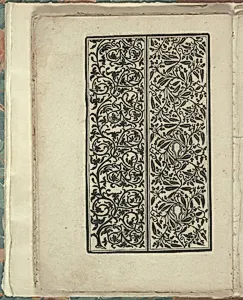
Opera Nova Universali intitulata Corona di racammi, page 31 (verso)
Medium
Woodcut
Dimensions
Overall: 8 7/8 x 6 7/8 in. (22.5 x 17.5 cm)
Classification
Books|Prints|Ornament & Architecture
Department
Drawings and Prints
Museum
Metropolitan Museum of Art, New York, NY
Credit
Harris Brisbane Dick Fund, 1932
Accession Number
32.54.1(62)
Rights
Public Domain
Tags
Art Historical Context
This woodcut comes from Giovanni Andrea Vavassore’s 1530 pattern bookOpera Nova Universali intitul Corona di racammi*, a popular Renaissance guide to embroidery designs. Printed in Venice, the volume offered artisans and needleworkers accessible models for decorating textiles with floral and foliate motifs. On page 31 verso, delicate leaf patterns demonstrate the elegant, repeating ornament typical of the period, intended to be transferred or adapted for clothing, linens, and furnishings. Vavassore, a printer and woodcut artist active in the early sixteenth century, specialized in such practical “ornament and architecture” publications. The woodcut medium allowed fine details to be reproduced affordably in multiple copies, spreading fashionable Italian designs across Europe. Measuring just under nine inches tall, the page exemplifies how printed pattern books democratized artistic knowledge during the Renaissance, transforming elite motifs into tools for everyday craftsmanship. Today in the Metropolitan Museum’s collection, this sheet preserves both the visual language of sixteenth-century decoration and the innovative print techniques that helped shape it. The gracefully curving leaves remind us how Renaissance artists blended natural observation with geometric order to create enduring ornamental vocabulary.
About the Artist
Giovanni Andrea Vavassore · 1530–1573
**Giovanni Andrea Vavassore (c. 1490s–1572)** Giovanni Andrea Vavassore, also known as Zoan Andrea or Guadagnino, hailed from Telgate near Bergamo in the Venetian terraferma and established himself in Venice by the early 16th century as a skilled wood engraver. His early life remains sparsely documented, with no records of formal training or mentors, though his initial output as a xylographer rev...