
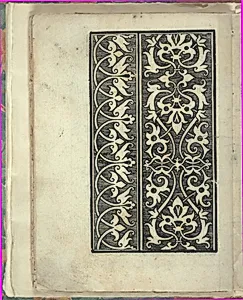
Opera Nova Universali intitulata Corona di racammi, page 36 (verso)
Medium
Woodcut
Dimensions
Overall: 8 7/8 x 6 7/8 in. (22.5 x 17.5 cm)
Classification
Books|Prints|Ornament & Architecture
Department
Drawings and Prints
Museum
Metropolitan Museum of Art, New York, NY
Credit
Harris Brisbane Dick Fund, 1932
Accession Number
32.54.1(72)
Rights
Public Domain
Tags
Art Historical Context
Step into the intricate world of Renaissance ornamentation with page 36 (verso) from *Opera Nova Univers intitulata Corona di rac* by Giovanni Andrea Vavass, a Venetian printer active around 1530. This woodcut print, measuring a compact 8 7/8 x 6 7/8 inches, captures delicate floral motifs blooming across the page—hallmarks of the era's fascination with nature-inspired designs. Published in Venice, a hub of printing innovation during the early 16th century, Vavassore's pattern book served as a "crown of embroideries," offering universal templates for lace, textiles, and decorative arts. Woodcuts like this one were ideal for the task: carved into wood blocks, they enabled affordable, reproducible patterns that artisans across Europe could trace and adapt, democratizing high-style decoration for homes, garments, and altars. Housed in the Metropolitan Museum of Art's Drawings and Prints department (acquired via the Harris Brisbane Dick Fund in 1932), this page exemplifies the Renaissance blend of utility and artistry. Its flowing flowers not only inspired needlework but also reflected humanism's embrace of botanical beauty, bridging fine art and craft in a single, timeless sheet.
About the Artist
Giovanni Andrea Vavassore · 1530–1573
**Giovanni Andrea Vavassore (c. 1490s–1572)** Giovanni Andrea Vavassore, also known as Zoan Andrea or Guadagnino, hailed from Telgate near Bergamo in the Venetian terraferma and established himself in Venice by the early 16th century as a skilled wood engraver. His early life remains sparsely documented, with no records of formal training or mentors, though his initial output as a xylographer rev...