
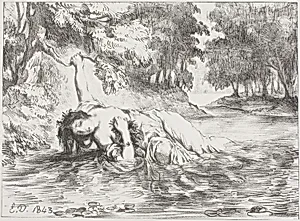
Ophelia's Death
1843
Medium
Lithograph in black on white wove paper
Dimensions
Image: 15.8 × 25.7 cm (6 1/4 × 10 1/8 in.); Sheet: 35.9 × 54.9 cm (14 3/16 × 21 5/8 in.)
Classification
lithograph
Department
Prints and Drawings
Museum
Art Institute of Chicago
Accession Number
66131
Rights
Public Domain
Art Historical Context
Eugène Delacroix'sOphelia's Death* (1843) captures a poignant moment from Shakespeare's *Ham*, where the tragic heroine Ophelia drowns amid floating flowers. As a leading figure of French Romanticism, Delacroix the scene with emotional intensity and dramatic naturalism, hallmarks of his style that rebelled against the rigid forms of Neoclassicism. Thisograph reflects his fascination with literary themes, blending sublime beauty with melancholy to evoke the fragility of life and madness. Printed in black ink on white wove paper, the work measures a modest image size of 15.8 × 25.7 cm within a larger sheet. Lithography, a revolutionary 19th-century technique Delacroix mastered, allowed him to achieve fluid, painterly lines and tonal gradations directly from his drawn sketches on stone—mimicking the expressiveness of his oil paintings while making art more accessible through multiples. Housed in the Art Institute of Chicago's Prints and Drawings department, this piece highlights Delacroix's innovative printmaking, bridging fine art and reproduction. It invites visitors to ponder Romanticism's emphasis on passion and the individual's inner turmoil, a cultural touchstone amid Europe's turbulent 1840s.
About the Artist
Eugène Delacroix · 1798–1863
Eugène Delacroix (1798–1863) stands as the defining figure of French Romanticism and a pivotal bridge to modernism. Born in Charenton-Saint-Maurice near Paris, he came from distinguished lineage—his mother descended from the prestigious Oeben-Riesener furniture dynasty, while persistent speculation suggested the statesman Talleyrand may have been his biological father, a theory supported by physic...