
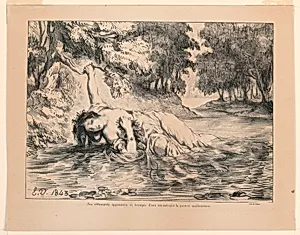
Illustration for Hamlet: The Death of Ophelia (IV, 7)
Medium
Classification
Department
Smithsonian Collection
Museum
Smithsonian American Art Museum
Credit
Smithsonian American Art Museum
Accession Number
1896-31-108
Rights
Public Domain
About this artwork
Research in Progress
Art Historical Context
Eugène Delacroix, towering figure of French Romanticism (1798–1863), created this poignant print in 1843 as an illustration for Shakespeare's *Hamlet*, capturing the tragic death of Ophelia in Act, Scene 7. In the play, Ophelia, driven mad by grief over her father Polonius's death and Hamlet's rejection, drowns a profusion of flowers. Delacroix's interpretation reflects his lifelong passion for Shakespeare, whose works he admired for their emotional depth and intensity, often turning to literature for inspiration in his dynamic compositions. As a lithograph—a printmaking technique Delacroix mastered— this work showcases his mastery of expressive line and shadow, evoking the Romantic emphasis on passion, nature, and human frailty. Prints like this made high art more accessible, disseminating Romantic ideals across Europe during a time of political upheaval, including the revolutionary fervor of 1848. Housed in the Smithsonian American Art Museum, it exemplifies how 19th-century artists bridged literature and visual art, inviting viewers to ponder Ophelia's sorrowful fate. Delacroix's Shakespeare illustrations, including this one, highlight his innovative fusion of coloristic painting with graphic precision, influencing generations of artists and underscoring the enduring cultural dialogue between English drama and French Romanticism.