
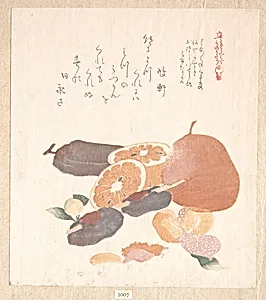
Oranges and Dried Persimmons
19th century
Medium
Woodblock print (surimono); ink and color on paper
Dimensions
8 x 7 1/16 in. (20.3 x 17.9 cm)
Classification
Prints
Culture & Period
Japan · Edo period (1615–1868)
Department
Asian Art
Museum
Metropolitan Museum of Art, New York, NY
Credit
H. O. Havemeyer Collection, Bequest of Mrs. H. O. Havemeyer, 1929
Accession Number
JP2007
Rights
Public Domain
Tags
Art Historical Context
Nestled among the vibrant still lifes of Japanese art, *Oranges and Dried Persimmons* a delicate woodblock print (surim) by Kubo Shunman, a masterful poet-printmaker of the late Edo period (1615–1868). Created in 19th century, intimate 8 x 7 1/16-inch work captures ripe oranges and hanging dried persimmons with luminous ink and color on paper, evoking the simple beauty of seasonal fruits. Surimono, meaning "printed things," were luxury commissions for private circles, often exchanged as New Year's greetings among literati, blending artistry with poetry. Shunman's ukiyo-e style shines in his precise rendering of textures—the glossy sheen of oranges against the papery translucence of persimmons—achieved through sophisticated woodblock techniques like subtle gradations (bokashi) and possible embossing for depth. In Edo Japan, such fruit depictions symbolized abundance and good fortune; persimmons, in particular, evoked autumn's bounty and wishes for prosperity. This print's cultural role highlights the era's refined aesthetic, where everyday motifs transcended the mundane. Part of the Metropolitan Museum of Art's H. O. Havemeyer Collection, it invites visitors to savor the quiet elegance of Japanese printmaking, a bridge between nature's ephemerality and enduring craft.
About the Artist
Kubo Shunman · 1757–1820
Japanese, 1757–1820