
Tangerine and Chinese Legend
spring 1871
Medium
Color woodblock print; surimono
Dimensions
27.2 × 18.5 cm (10 3/4 × 7 5/16 in.)
Classification
woodblock print
Department
Arts of Asia
Museum
Art Institute of Chicago
Accession Number
42893
Rights
Public Domain
About this artwork
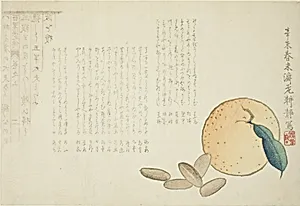
This print is a finely produced summer scene with a tangerine and nuts on embossed chrysanthemum-design paper. The upper-left edge shows a piece of paper from the back, cleverly indicating the paper on which the objects were placed. The paper (with its characters in reverse) describes the biography of the Chinese hero Baili Xi, who was an influential prime minister of the state of Qin during the Spring and Autumn Period in ancient China. With the guidance of Baili, the Qin state was able to wag...
Art Historical Context
In the spring of 1871, Japanese artist Kosei created *Tangerine and Chinese*, a delicate color woodblock print known as a *surimono*. Measuring just 27.2 × 18.5 cm, this intimate format was typical of *surimono*, privately commissioned prints often produced for poetry gatherings, New Year's celebrations, or elite patrons. Unlike mass-produced ukiyo-e, *surimono* featured luxurious techniques like embossing, mica dusting, and vibrant pigments, making each one a treasured object of art and literature. The title evokes a poetic fusion of everyday beauty—a ripe tangerine, symbolizing spring's renewal in Japanese culture—and motifs from Chinese legend, reflecting the era's deep Sino-Japanese artistic exchange. Produced during Japan's Meiji Restoration (1868–1912), when traditional woodblock printing coexisted with Western influences, this work captures ukiyo-e's fading golden age. Kosei's precise carving and layering of colors highlight the medium's technical mastery, where multiple woodblocks were hand-printed to achieve depth and luminosity. Housed in the Art Institute of Chicago's Arts of Asia department, *Tangerine and Chinese Legend* invites visitors to appreciate how such prints bridged personal expression and cultural heritage, offering a window into 19th-century Japan's refined aesthetic world.