
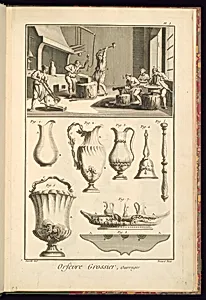
Orfèvre Grossier, Ouvrages
Classification
Department
Smithsonian Collection
Museum
Smithsonian American Art Museum
Credit
Purchased for the Museum by the Advisory Council
Accession Number
1921-6-344-1
Rights
Public Domain
About this artwork
Research in Progress
Art Historical Context
This 1762 print by French artist J.R. Lucotte (1733–1784), titled *Orfèvre Grossier, Ouvrages*, captures a moment in the rich tradition of 18th-century European craft illustration. Produced during the Enlightenment, when curiosity about trades, science, and the decorative arts flourished, the work likely depicts goldsmithing—suggested by the title’s reference to a goldsmith and finished pieces. Lucotte created it as a young artist in a France alive with intellectual exchange and technical innovation. As a print, it belongs to a medium that allowed detailed images of workshops, tools, and luxury objects to circulate widely among artisans, collectors, and scholars. Engraving and related techniques of the period enabled precise line work that both documented skilled labor and celebrated the beauty of metalwork. Such images helped preserve knowledge of specialized crafts at a time when guilds and academies were shaping artistic standards. Now in the Smithsonian American Art Museum collection (acquired by the Advisory Council), this print invites viewers to consider how art and industry intertwined in pre-Revolutionary France. It offers a window onto the elegance and exacting standards of goldsmithing, reminding us that even utilitarian objects were once rendered with artistic care.