
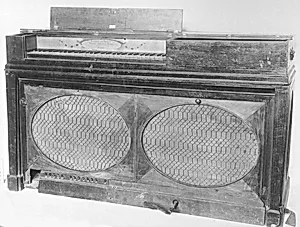
Organized square piano (square piano and pipe organ)
Medium
Mahogany, iron, ivory, ebony, various materials
Dimensions
Case Length (perpendicular to keykboard): 56.1 cm; W. (parallel to keyboard): 156.9 cm; Case depth without lid: 20.9 cm; Total H. 94.8 cm
Classification
Chordophone and Aerophone-struck piano/ free reed keyboard
Culture
British
Department
Musical Instruments
Museum
Metropolitan Museum of Art, New York, NY
Credit
The Crosby Brown Collection of Musical Instruments, 1889
Accession Number
89.4.2803
Rights
Public Domain
Art Historical Context
Step into the enchanting world of 18th-century musical innovation with this *Organized square piano*, remarkable hybrid instrument crafted around 1786, possibly by Eaton Pelhem in collaboration with the esteemed British firm Longman & Broderip. Housed in the Metropolitan Museum of Art's Crosby Brown Collection of Musical, this British gem blends the delicate touch of a square piano—a compact, rectangular keyboard instrument popular in genteel homes—with the majestic tones of a pipe organ, earning its "organized" moniker. Fashioned from rich mahogany with iron mechanisms, ivory and ebony keys, and various materials, it measures a modest 156.9 cm wide (parallel to the keyboard), 56.1 cm long, and 94.8 cm tall—perfect for domestic parlors. Classified as both a chordophone (struck piano strings) and aerophone (free reed and pipe organ sounds), it allowed players to switch between piano's expressive hammers and organ's sustained, wind-driven pipes, showcasing the era's experimental spirit. This piece captures the Classical period's fusion of technology and artistry, when makers like Longman & Broderip pushed boundaries to bring orchestral grandeur into everyday life. A testament to British craftsmanship, it invites visitors to imagine candlelit soirées alive with its versatile melodies.
About the Artist
Eaton Pelham (?)|Longman & Broderip (British| ) · 1750 | –1850 |
British, mid-18th century|