
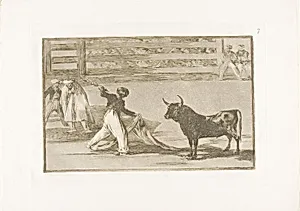
Origin of the harpoons or banderillas, plate seven from The Art of Bullfighting
1814/16, published 1816
Medium
Etching, burnished aquatint and burin on ivory laid paper
Dimensions
Image: 20.1 × 31.5 cm (7 15/16 × 12 7/16 in.); Plate: 24.5 × 35.2 cm (9 11/16 × 13 7/8 in.); Sheet: 32 × 44.5 cm (12 5/8 × 17 9/16 in.)
Classification
etching
Department
Prints and Drawings
Museum
Art Institute of Chicago
Accession Number
123715
Rights
Public Domain
Art Historical Context
Francisco José de Goya y Lucientes, the visionary Spanish artist of the late 18th and early 19th centuries, the raw drama of Spain's national pastime in his groundbreaking series *La Tauromaquia* (*The Art of Bullfighting This etching, titled *Origin of the Harpoons or Banderillas* and known as plate seven, was created between 1814 and 1816 and published in 1816. Amid the turmoil of the Napoleonic Wars and Spain's turbulent restoration, Goya turned to bullfighting—a symbol of Spanish identity, bravery, and spectacle—to explore human passion and mortality. The series of 33 prints meticulously documents the sport's techniques, history, and myths, blending Romantic intensity with unflinching realism. In this plate, Goya illustrates the legendary origins of the banderillas, the barbed harpoons thrust into the bull to weaken it during the corrida. His masterful use of etching, burnished aquatint for velvety tonal gradients, and burin for crisp lines on ivory laid paper creates a dynamic scene of shadowed figures and taut action. The modest image size (20.1 × 31.5 cm) belies its monumental energy, with aquatint's smoky depths evoking the dust-choked arena and flickering torchlight. Housed in the Art Institute of Chicago's Prints and Drawings Department, this work exemplifies Goya's printmaking genius, bridging Enlightenment observation with proto-modern critique. It invites visitors to ponder bullfighting's cultural grip on Spain—part ritual, part theater—while marveling at Goya's ability to immortalize fleeting violence in enduring art.
About the Artist
Francisco José de Goya y Lucientes · 1746–1828
Francisco José de Goya y Lucientes was born on March 30, 1746, in the small Aragonese village of Fuendetodos, Spain, to José Benito de Goya, a master gilder, and Gracia de Lucientes. The fourth of six children in a modest lower-middle-class family, Goya received a basic education before beginning his artistic training at age 14 under the local painter José Luzán y Martínez in Zaragoza, where he sp...