
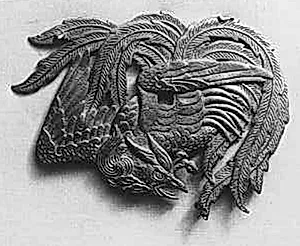
Ornament
Unknown Artist
17th century
Medium
Iron
Dimensions
H. 2 1/2 in. (6.4 cm); W. 3 1/2 in. (8.9 cm)
Classification
Metalwork
Culture & Period
Japan · Momoyama (1573–1615) or Edo period (1615–1868)
Department
Asian Art
Museum
Metropolitan Museum of Art, New York, NY
Credit
Rogers Fund, 1912
Accession Number
12.37.148
Rights
Public Domain
Tags
Art Historical Context
This delicate iron ornament, crafted by an unknown Japanese artist in the 17th century during late Momoyama (1573–1615) or early Edo period (1615–1868), measures just 2½ by 3½ inches, making it a exquisite example of miniature metalwork artistry. Acquired through the Rogers Fund in 1912 and now housed in the Metropolitan Museum of Art's Asian Art Department, it showcases the precision of Japanese iron forging techniques, where skilled artisans transformed raw metal into intricate designs. Bird motifs, as tagged here, were popular in Japanese decorative arts, symbolizing grace, freedom, and seasonal beauty—common themes in a culture deeply attuned to nature. During the Momoyama era's bold aesthetics and the Edo period's refined craftsmanship, such ornaments often adorned sword fittings, lacquerware, or personal items, blending functionality with artistry. Iron's durability suited these utilitarian yet ornamental roles, hammered and possibly patinated for a subtle luster. This piece invites us to appreciate Japan's metalworking legacy, where everyday iron became a canvas for poetic expression amid feudal society's transitions. A testament to anonymous mastery, it whispers stories of warriors and poets alike.