
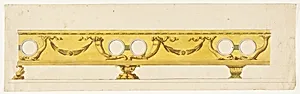
Ornament Design
19th century
Medium
Pen and ink and watercolor on laid paper
Dimensions
sheet: 18 7/16 x 5 1/2 in. (46.8 x 13.9 cm)
Classification
Drawings
Department
Drawings and Prints
Museum
Metropolitan Museum of Art, New York, NY
Credit
The Elisha Whittelsey Collection, The Elisha Whittelsey Fund, 1953
Accession Number
53.692.21
Rights
Public Domain
Tags
Art Historical Context
Step into the elegant world of 19th-century French decorative arts with this delicate *Ornament Design*, an anonymous drawing from the Metropolitan Museum of Art's esteemed Elisha Whittelsey Collection. Created on laid paper—a handmade sheet with distinctive parallel laid lines that were prized for their texture and absorbency—this work exemplifies the meticulous planning behind the era's lavish interiors, furniture, and textiles. Measuring 18 7/16 x 5 1/2 inches, its narrow format suggests it was likely a preparatory sketch for repeating motifs in architecture or wallpaper. In 19th-century France, amid the Romantic and historicist revivals, ornament designs like this fueled a booming decorative industry. Artists and workshops produced intricate patterns drawing from Gothic, Renaissance, and Oriental influences, bridging handmade craftsmanship with emerging industrialization. The use of pen and ink provided precise lines for symmetry and detail, while watercolor added vibrant hues, allowing designers to visualize final color schemes vividly. Though unattributed, this piece highlights the collaborative anonymity of design ateliers, where ideas flowed freely to inspire grand salons and public spaces. A testament to France's enduring legacy in ornamental elegance, it invites us to appreciate the unseen artistry shaping everyday beauty.
About the Artist
Anonymous, French, 19th century · 1800–1900
**Anonymous, French, 19th Century (ca. 1800–1900)** The artist cataloged as Anonymous, French, 19th century embodies the enigmatic yet essential contributions of unidentified creators to France's vibrant 19th-century art world. Active roughly between 1800 and 1900, this figure—or potentially collective workshop—produced a diverse array of works amid the nation's transition from Neoclassicism thro...