
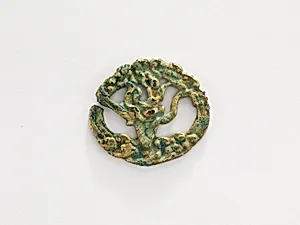
Ornament: immortal, crane, and clouds (pair with F1916.475)
12th-13th century
Classification
Jewelry and Ornament
Department
Smithsonian Collection
Museum
Smithsonian American Art Museum
Credit
Gift of Charles Lang Freer
Accession Number
F1916.725
Rights
Public Domain
Tags
About this artwork
To 1916
Art Historical Context
This exquisite bronze ornament from Korea's Goryeo period (918–1392), dating to the 12th–13th century, captures timeless symbols of immortality: a crane soaring amid swirling clouds, paired with a companion piece (F1916.475). Crafted using lost-wax casting and adorned with gilding, it exemplifies the era's masterful metalwork, where gold leaf enhanced bronze's durability and luster, making such pieces prized personal adornments or ritual objects. In Goryeo Buddhist and Confucian culture, cranes embodied longevity and good fortune, while immortals (often depicted with them) drew from Taoist lore, evoking eternal life and spiritual ascent. These motifs reflect the dynasty's artistic fusion of indigenous traditions with continental influences, showcasing Korea's sophisticated ornamental arts amid political and religious flourishing. A gift to the Smithsonian from collector Charles Lang Freer, this artifact highlights Goryeo's legacy in gilded bronzes, now preserved in the Smithsonian American Art Museum's collection. Visitors will appreciate its delicate symbolism, a window into medieval Korea's aspirations for the divine.
About the Artist
Unknown
The artist designated as "Unknown" in our virtual museum's collection exemplifies a poignant chapter in art history: creators whose identities have faded into obscurity despite the enduring power of their work. With only one known artwork attributed to them in our holdings, this figure represents countless anonymous hands that shaped visual culture across centuries. Museums worldwide, including th...