
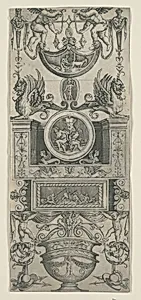
Ornament Panel
Medium
Engraving
Dimensions
10 5/16 x 4 5/16 in. (26.2 x 11.0 cm)
Classification
Prints|Ornament & Architecture
Department
Drawings and Prints
Museum
Metropolitan Museum of Art, New York, NY
Credit
The Elisha Whittelsey Collection, The Elisha Whittelsey Fund, 1949
Accession Number
49.95.41
Rights
Public Domain
Tags
Art Historical Context
Created in 1521 by the Italian engraver Agostino Veneziano, this delicate ornament panel exemplifies the Renaissance fascination with classical motifs. Measuring just over ten inches tall, the engraving features a sphinx integrated into an intricate decorative scheme, reflecting the period’s revival of ancient Egyptian and Greco-Roman imagery. As part of the “Ornament & Architecture” category, such prints served as pattern books for artists, architects, and craftsmen seeking elegant designs for furniture, textiles, and architectural details. Veneziano, active in Rome during the height of the High Renaissance, was renowned for his precise burin work that captured both sculptural volume and ornamental flourish. Engravings like this one allowed ornamental ideas to circulate widely across Europe, democratizing access to sophisticated decorative vocabulary previously reserved for courtly or ecclesiastical patrons. The sphinx, a creature symbolizing mystery and wisdom, adds an exotic note that appealed to collectors and designers alike. Housed today in the Metropolitan Museum of Art’s Department of Drawings and Prints, the panel survives as a testament to the enduring appeal of Renaissance ornament. Its crisp lines and balanced composition continue to offer viewers a window into how sixteenth-century artists reimagined antiquity for contemporary use.