
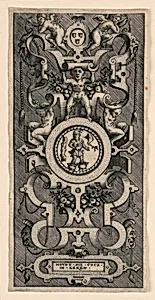
Scrollwork Escutcheon
Classification
Department
Smithsonian Collection
Museum
Smithsonian American Art Museum
Credit
Museum purchase through gift of Mrs. John I. Kane
Accession Number
1944-83-10
Rights
Public Domain
About this artwork
Research in Progress
Art Historical Context
Behold the *Scrollwork Escutcheon*, a captivating print crafted in 1566 by Jacob Floris the Elder, a Flemish artist (1524–1581) renowned for his intricate ornamental designs during the Northern Renaissance. Housed in the Smithsonian American Art Museum through a generous museum purchase funded by Mrs. John I. Kane, this work exemplifies the era's fascination with elaborate decoration, where escutcheons—shield-like emblems—served as heraldic or architectural focal points adorned with flowing scrollwork. As a print, likely an engraving, the piece highlights the revolutionary role of printmaking in 16th-century Flanders. This medium allowed artists like Floris to disseminate complex motifs widely, influencing goldsmiths, architects, and book illustrators across Europe. The swirling scrolls evoke Mannerist tendencies toward elegance and fantasy, blending Gothic flourishes with emerging Renaissance symmetry. Though research continues, this escutcheon invites us to marvel at Flemish craftsmanship's precision and whimsy, a testament to how decorative arts bridged utility and beauty in the Renaissance world.