
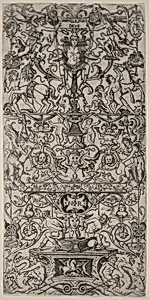
Ornament Panel: Mars, God of Battles
c. 1507
Medium
engraving
Dimensions
sheet (trimmed to plate mark): 26.2 x 12.9 cm (10 5/16 x 5 1/16 in.)
Classification
Department
CG-E
Museum
National Gallery of Art, Washington, D.C.
Credit
Rosenwald Collection
Accession Number
1943.3.7414
Rights
Public Domain
Art Historical Context
**Ornament Panel: Mars, God of Battles** *by Nicoletto da Modena, c. 1507* Engraving, 26.2 x 12.9 cm National Gallery of Art, Rosenwald Collection Step into the Renaissance world of intricate design with Nicoletto da Modena's *Ornament Panel: Mars, God of Battles*, an exquisite engraving from around 1507. Nicoletto, a masterful Italian printmaker active in the late 15th and early 16th centuries, specialized in ornamental engravings that blended classical mythology with decorative flair. This compact panel (trimmed to its plate mark) captures Mars, the Roman god of war, amid swirling motifs—perfect for inspiring goldsmiths, architects, and artisans during Italy's High Renaissance. Engraving, Nicoletto's chosen medium, revolutionized art dissemination. By incising fine lines into a metal plate, inking it, and pressing paper against it, artists like him could produce detailed, reproducible designs affordable for widespread use. Nicoletto's style echoes the grotesque ornaments popularized by contemporaries like Leonardo da Vinci, featuring bold, intertwined patterns that evoke ancient Roman frescoes. Mars here symbolizes martial prowess, reflecting the era's fascination with classical antiquity amid Italy's turbulent city-state rivalries. This print's survival in the National Gallery of Art's Rosenwald Collection highlights its enduring appeal. At just over 10 by 5 inches, it packs a punch of technical virtuosity, inviting visitors to marvel at how a god of battles could inspire peaceful beauty in everyday Renaissance crafts.
About the Artist
Nicoletto da Modena · 1500–1520
Nicoletto da Modena was an Italian engraver active in the late fifteenth and early sixteenth centuries, one of the most prolific and stylistically eclectic printmakers of the early Italian Renaissance. The details of his biography remain uncertain — his precise birth and death dates are unknown, and he is identified primarily through the body of prints that bear his name or monogram. He appears to...