
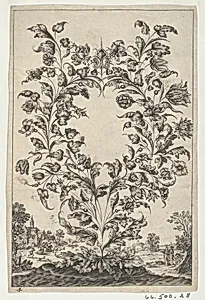
Ornament with Jewelry Design as Decorative Floral Arrangement
17th century
Medium
Engraving
Dimensions
Sheet: 6 1/4 × 4 1/2 in. (15.9 × 11.5 cm)
Classification
Prints|Ornament & Architecture
Department
Drawings and Prints
Museum
Metropolitan Museum of Art, New York, NY
Credit
The Elisha Whittelsey Collection, The Elisha Whittelsey Fund, 1966
Accession Number
66.500.28
Rights
Public Domain
Tags
Art Historical Context
This delicate 17th-century engraving, titled *Ornament with Jewelry Design as Decorative Floral Arrangement*, showcases the inventive spirit of ornamental printmaking during the Baroque era. Created by an anonymous artist, the work transforms jewelry motifs into an elegant bouquet of flowers and leaves, blending natural forms with the precision of decorative design. At just 6 1/4 by 4 1/2 inches, the compact sheet was likely intended as a model or pattern for craftsmen working in goldsmithing, embroidery, or metalwork. Engravings like this played a vital role in disseminating artistic ideas across Europe, allowing jewelers and artisans to study and adapt intricate patterns without needing direct access to original pieces. The classification under Ornament & Architecture highlights its practical purpose: serving as both aesthetic inspiration and technical guide. The Met’s acquisition through the Elisha Whittelsey Collection underscores its value as a surviving example of how everyday decorative arts were elevated through fine print techniques. Visitors can appreciate the meticulous linework that captures the softness of petals alongside the structured geometry of jewelry settings. Such prints reveal the period’s fascination with merging the organic and the ornate, inviting us to see flowers not only as elements of nature but as sources for wearable beauty.
About the Artist
Anonymous, 17th century · 1600–1700
**Anonymous, 17th century** remains one of the most intriguing figures—or rather, non-figures—in art history, representing the countless unnamed painters, draftsmen, and sculptors whose works survive from the Baroque era. Active across Europe between 1600 and 1700, this designation encompasses artists whose identities have been lost to time, yet whose output forms a substantial part of museum coll...