
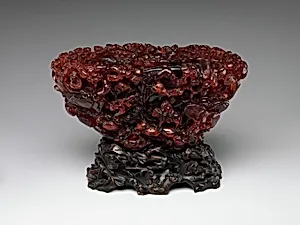
清 琥珀山水人物擺件|Ornament with landscape and figures
Unknown Artist
Medium
Amber
Dimensions
H. 4 in. (10.2 cm); L. 7 3/4 in. (19.7 cm)
Classification
Amber
Culture & Period
China · Qing dynasty (1644–1911)
Department
Asian Art
Museum
Metropolitan Museum of Art, New York, NY
Credit
Bequest of Mary Clark Thompson, 1923
Accession Number
24.80.109
Rights
Public Domain
Tags
Art Historical Context
This exquisite amber ornament, titled *Ornament with Landscape and Figures hails from China's Qing dynasty (1644–1911 a period renowned for its refined scholarly arts and imperial craftsmanship. Carved from a single piece of translucent amber—likely from Baltic regions via maritime trade routes—the sculpture stands just 4 inches high and 7¾ inches long, making it a delicate display piece摆件) perfect for scholar's desk or elite household altar. Its surface captures a miniature world of rugged mountains, winding rivers, and tiny human figures engaged in daily pursuits, evoking the timeless harmony of man and nature central to Chinese literati culture. Amber's rarity in Chinese art underscores its prestige; softer and more brittle than jade or ivory, it demanded masterful carving techniques to avoid cracking, revealing glowing amber hues and inclusions that mimic mist-shrouded landscapes. Such ornaments symbolized wealth and aesthetic refinement, often appreciated for their luminous quality under candlelight. Donated to the Metropolitan Museum of Art in 1923 through the bequest of Mary Clark Thompson, this piece offers a glimpse into Qing-era ingenuity, blending natural material with poetic imagery. (198 words)