
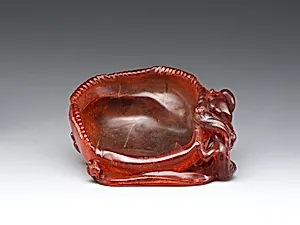
Dish in Form of a Leaf
Unknown Artist
18th century
Medium
Reddish amber
Dimensions
H. 2 7/8 in. (7.3 cm); W. 4 3/4 in. (12.1 cm); L. 4 1/4 in. (10.8 cm)
Classification
Amber
Culture
China
Department
Asian Art
Museum
Metropolitan Museum of Art, New York, NY
Credit
Gift of Heber R. Bishop, 1902
Accession Number
02.18.923
Rights
Public Domain
Art Historical Context
This delicate *Dish in Form of a*, crafted in the 18th century China's Qing dynasty, exemplifies the refined artistry of the era. Shaped like a natural leaf with subtle veining and an elegantly curved rim, the piece measures just 2⅞ inches high, 4¾ inches wide, and 4¼ inches long—perfectly sized for a scholar's desk or as a trinket dish. Its warm, reddish amber hue glows translucently, inviting viewers to appreciate its organic beauty up close. Amber, fossilized tree resin prized in Chinese culture for its rarity and luster, was a favored material for intricate carvings among elite artisans. Carving such a brittle medium demanded exceptional skill to mimic nature's forms without fracture, reflecting the Qing emphasis on harmony between art and the natural world. Leaf motifs symbolized renewal and vitality, often adorning objects for the literati class. A gift to the Metropolitan Museum of Art from Heber R. Bishop in 1902, this anonymous masterpiece highlights China's mastery of hardstone techniques, bridging decorative function with poetic elegance. Visitors can marvel at how it captures the ephemeral grace of a fallen leaf in enduring amber.