
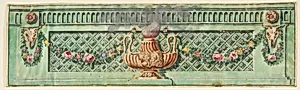
Ornamental Panel with Flaming Lamp and Floral Swags
19th century
Medium
Watercolor on vellum
Dimensions
sheet: 4 x 14 in. (10.2 x 35.6 cm)
Classification
Drawings
Department
Drawings and Prints
Museum
Metropolitan Museum of Art, New York, NY
Credit
Gift of Harry G. Friedman, 1962
Accession Number
62.635.200
Rights
Public Domain
Tags
Art Historical Context
This delicate *Ornamental Panel with Flaming Lamp and Floral Sw*, created by an anonymous French artist in 19th century, the era's passion for ornate decorative arts. Rendered in watercolor on vellum—a fine, translucent parchment made from animal skin—the work measures just 4 x 14 inches, suggesting it served as a design model for larger applications like furniture panels, wall decorations, or bookbindings. The central flaming lamp, symbolizing enlightenment and prosperity, is framed by lush floral swags or garlands, evoking and classical motifs revived during France's Romantic and Second Empire periods. Watercolor on vellum allowed for the luminous, jewel-like colors and intricate detailing that bring the composition to life, a technique prized for its precision and portability in ateliers. Such ornamental drawings were vital in the decorative trade, bridging fine art and craft, and reflecting the opulent tastes of bourgeois homes and public spaces. Though anonymous, the artist's skill highlights the collaborative world of 19th-century French design workshops. Today, this charming piece resides in the Metropolitan Museum of Art's Drawings and Prints department, a 1962 gift from Harry G. Friedman, inviting visitors to appreciate the subtle artistry behind everyday elegance.
About the Artist
Anonymous, French, 19th century · 1800–1900
**Anonymous, French, 19th Century (ca. 1800–1900)** The artist cataloged as Anonymous, French, 19th century embodies the enigmatic yet essential contributions of unidentified creators to France's vibrant 19th-century art world. Active roughly between 1800 and 1900, this figure—or potentially collective workshop—produced a diverse array of works amid the nation's transition from Neoclassicism thro...