
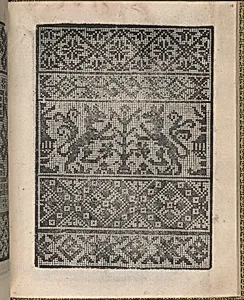
Ornamento delle belle & virtuose donne, page 14 (recto)
Medium
Woodcut
Dimensions
Overall: 7 1/2 x 5 7/8 in. (19 x 15 cm)
Classification
Books|Prints|Ornament & Architecture
Department
Drawings and Prints
Museum
Metropolitan Museum of Art, New York, NY
Credit
Rogers Fund, 1921
Accession Number
21.15.2bis(27)
Rights
Public Domain
Tags
Art Historical Context
In the Renaissance era, Venetian publisher and engraver Matteo Pagano produced *Ornamento delle belle & virtuose donne* ("Ornament for Beautiful and Virtuous Women") in 1554, a delightful pattern book offering intricate designs for embroidery, lace, and textiles tailored to women's fashion and crafts. This woodcut on page 14 (recto), measuring a compact 7 1/2 x 5 7/8 inches, exemplifies the era's booming market for ornamental prints, which democratized elaborate motifs for artisans across Europe. Housed in the Metropolitan Museum of Art's Drawings and Prints department (acquired via the Rogers Fund in 1921), it reflects the classification of books, prints, and ornament & architecture. The page showcases bold, symmetrical woodcut designs featuring lions—a symbol of strength and nobility—interwoven with scrolling foliage and geometric patterns. Woodcuts like this allowed for affordable reproduction of fine details, with the raised woodblock inked and pressed onto paper, creating crisp black lines ideal for tracing or scaling up in workshops. Pagano's style, rooted in Mannerist elegance, blended classical motifs with playful fantasy, influencing dressmakers and jewelers. Culturally, such books empowered women as creators and consumers of beauty, bridging art and daily life amid Venice's printing revolution. Lions evoke heraldry and virtue, reminding us how Renaissance ornaments encoded ideals of grace and power. A charming window into 16th-century design ingenuity!
About the Artist
Matteo Pagano|Lloyd, Wallis & Lloyd · 1515–1588
**Matteo Pagano (c. 1515–1588)** was a prominent Venetian printer, publisher, woodcut artist, and illustrator whose innovative designs bridged fine art and the decorative crafts during the Renaissance. Little is known about his early life, which remains sparsely documented, but he began his career as a woodblock cutter, working for the publisher Nicolò Zoppino on pattern books before establishing ...