
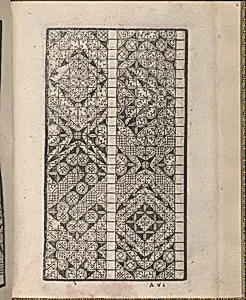
Ornamento delle belle & virtuose donne, page 4 (recto)
Medium
Woodcut
Dimensions
Overall: 7 1/2 x 5 7/8 in. (19 x 15 cm)
Classification
Books|Prints|Ornament & Architecture
Department
Drawings and Prints
Museum
Metropolitan Museum of Art, New York, NY
Credit
Rogers Fund, 1921
Accession Number
21.15.2bis(7)
Rights
Public Domain
Tags
Art Historical Context
Step into the Renaissance world of elegance with *Ornamento delle belle & virtu donne* (Ornament for Beautiful and Virt Women), page 4recto), a delicate woodcut print created by publisher and engraver Matteo Pagano 1554. This page, measuring just 7½ x 5⅞ inches, hails from a pattern book designed to inspire women in crafting decorative motifs for embroidery, lace, and textiles—reflecting the era's fascination with beauty, virtue, and domestic artistry. Woodcuts like this one were revolutionary for their time, a relief printing technique that allowed for affordable, reproducible designs in books. Pagano, a key figure in Venice's vibrant print culture, produced these intricate ornamental patterns blending floral, architectural, and geometric elements, influencing fashion, interiors, and even jewelry across Europe. Such books democratized high-style decoration, empowering "belle & virtuose donne" to adorn their lives with sophisticated flair. Today, housed in the Metropolitan Museum of Art's Drawings and Prints department (acquired via the Rogers Fund in 1921), this page whispers of 16th-century Italy's cultural bloom, where art met everyday creativity in harmonious symmetry.
About the Artist
Matteo Pagano|Lloyd, Wallis & Lloyd · 1515–1588
**Matteo Pagano (c. 1515–1588)** was a prominent Venetian printer, publisher, woodcut artist, and illustrator whose innovative designs bridged fine art and the decorative crafts during the Renaissance. Little is known about his early life, which remains sparsely documented, but he began his career as a woodblock cutter, working for the publisher Nicolò Zoppino on pattern books before establishing ...