
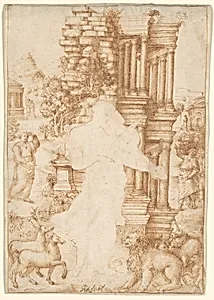
Orpheus
early 16th century
Medium
Pen and brown ink
Dimensions
9 3/16 x 6 7/16 in. (23.4 x 16.4 cm)
Classification
Drawings
Culture
Central Italian
Department
Robert Lehman Collection
Museum
Metropolitan Museum of Art, New York, NY
Credit
Robert Lehman Collection, 1975
Accession Number
1975.1.253
Rights
Public Domain
Tags
Art Historical Context
This delicate pen and brown ink drawing, titledOrpheus*, hails from Central Italy in the early th century, a golden age of Renaissance artistry. It captures the mythical musician Orpheus, famed in classical lore for his lyre that enchanted wild beasts. Here, he appears amid deer and lions—symbols of nature's harmony under music's spell—evoking the era's fascination with ancient Greek and Roman tales as a bridge to humanism and beauty. Crafted with precise lines in brown ink on a modest sheet (9 3/16 x 6 7/16 in.), the work exemplifies Renaissance draughtsmanship. Pen and ink allowed artists fluid expression for studies or standalone pieces, showcasing mastery of contour, shading, and movement. Central Italian masters like those from Florence or Rome prized such techniques for their preparatory role in grand paintings or sculptures. Now in the Robert Lehman Collection at The Metropolitan Museum of Art (acquired 1975), this drawing highlights the Renaissance revival of mythological themes, blending poetic narrative with technical virtuosity. It invites visitors to ponder music's timeless power over the savage world.
About the Artist
Italian
The designation "Italian" in art collections typically refers to an anonymous artist or a loose attribution to works from Italian schools, rather than a specific individual. With 173 known artworks in the museum's collection, this entry likely encompasses paintings by unidentified masters active across various periods, such as the Renaissance, Baroque, or later eras. Early life and personal detail...