
Ostrakon with a Letter from Lazarius to Epiphanius
Unknown Artist
ca. 600
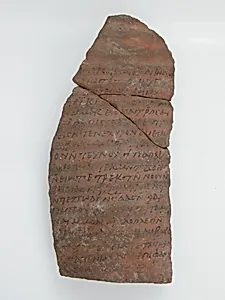
Medium
Pottery fragment with ink inscription
Dimensions
3 15/16 x 7 7/8 in. (10 x 20 cm)
Classification
Ceramics
Culture
Coptic
Department
Medieval Art
Museum
Metropolitan Museum of Art, New York, NY
Credit
Rogers Fund, 1914
Accession Number
14.1.163
Rights
Public Domain
Art Historical Context
This unassuming pottery fragment, known as an *ostrakon*, captures a slice of everyday life in Coptic Egypt around 600 AD. Measuring just under 8 inches long, it bears an ink inscription—a personal letter from Lazarius to Epiphani—scribed on a broken shard of ceramic. Ostraka like this were the ancient equivalent of scrap paper, reused for notes, letters, and accounts when papyrus was scarce or costly, offering invaluable glimpses into the daily communications of ordinary people in late antique Egypt. In the Coptic Christian world of early medieval Egypt, under Byzantine influence, such artifacts reveal a vibrant literate culture among monks, farmers, and merchants. The letter's Coptic script (likely in its Greek-derived alphabet) highlights the community's religious and social ties, with names evoking biblical figures like Lazarus. As a ceramic inscription, it showcases simple yet durable ink techniques on unglazed pottery, preserving intimate human exchanges amid a fading classical world. Housed in the Metropolitan Museum of Art's Medieval Art department since 1914, this ostrakon bridges art and history, reminding us that the most profound stories often hide in humble fragments. Visitors, imagine reading a 1,400-year-old message—proof that some bonds endure across millennia!