
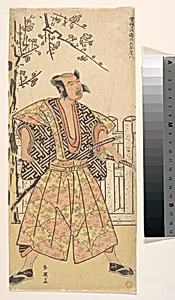
Otani Hirohachi as a Samurai Dressed in a Gaudy Kamishimo
December 1790
Medium
Woodblock print; ink and color on paper
Dimensions
11 9/16 x 5 5/8 in. (29.4 x 14.3 cm)
Classification
Prints
Culture & Period
Japan · Edo period (1615–1868)
Department
Asian Art
Museum
Metropolitan Museum of Art, New York, NY
Credit
Purchase, Joseph Pulitzer Bequest, 1918
Accession Number
JP321
Rights
Public Domain
Tags
Art Historical Context
This vibrant woodblock print by Katsukawa Shun'ei captures the kabuki actor Otani Hirohachi in the role of a samurai, clad in a striking kamishimo—a formal, wide-shouldered outfit often worn by warriors on stage. Created in December 1790 during Japan’s Edo period, the work reflects the era’s thriving theater culture, when actors were celebrated celebrities whose performances inspired countless ukiyo-e prints. Shun'ei, a leading artist of the Katsukawa school, specialized in dynamic portraits of performers, emphasizing expressive poses and bold costumes that brought the excitement of the kabuki stage to everyday viewers. As a woodblock print in ink and color on paper, the piece exemplifies the accessible yet sophisticated printmaking techniques of the time, allowing multiple impressions to circulate among a growing urban audience. The vivid depiction of the actor’s attire highlights the theatrical flair of samurai roles, blending historical costume with dramatic exaggeration typical of kabuki. Housed in the Metropolitan Museum of Art’s Asian Art collection, this print offers a window into late-18th-century Japanese entertainment and fashion, preserving a moment when art and popular culture intertwined.
About the Artist
Katsukawa Shun'ei 勝川春英 (Japanese) · 1762 –1819
Japanese, 1762–1819