
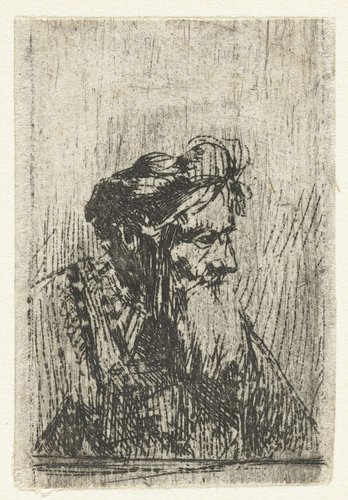
Oude man met baard en tulband
1630 - 1700
Medium
etching
Dimensions
34; 49
Rights
Public Domain
About this artwork
height 49 mm x width 34 mm
Art Historical Context
Behold the delicate etching *Oude man met baard en tulband* ("Old Man with Beard and Turban"), an anonymous work from the Dutch Golden Age, created sometime between 1630 and 1700. Measuring just 49 mm high by 34 mm wide, this intimate portrait captures a weathered face framed by a flowing beard and an exotic turban, evoking mystery and character in its miniature scale. Such small prints were prized by collectors, easily carried in pockets or albums as affordable art treasures. Etching, the medium here, was a revolutionary intaglio technique perfected in the 17th-century Netherlands. Artists drew lines into a wax-coated copper plate with a needle, then submerged it in acid to etch the grooves, allowing ink to cling deeply for rich, expressive lines upon printing. This method enabled intricate details—like the man's textured skin and fabric folds—that rivaled larger paintings, making high art accessible beyond the elite. In the vibrant era of Dutch trade and exploration via the East India Company, turbans symbolized Eastern influences, blending portraiture with cultural curiosity. Though anonymous, this tronie-like study (a Dutch specialty of expressive "head" studies) reflects the period's mastery of realism and human observation, inviting us to ponder the old man's untold story. A window into 17th-century life, preserved in miniature brilliance.
About the Artist
anonymous
In the vast tapestry of art history, "Anonymous" stands not as a singular individual but as a collective designation for countless unidentified creators whose works have endured across millennia. These artists, spanning prehistoric cave painters to medieval illuminators and folk craftsmen, produced the foundational layers of human visual culture. Prior to the Renaissance, when individual fame emer...