
Out for a Walk
1868
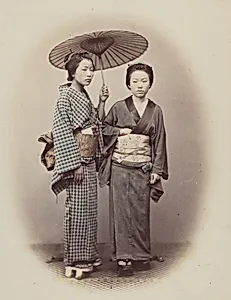
Medium
albumen print with applied color
Dimensions
image (oval): 22.5 × 16.5 cm (8 7/8 × 6 1/2 in.) sheet: 25.4 × 20.4 cm (10 × 8 1/16 in.) mount: 49.5 × 35 cm (19 1/2 × 13 3/4 in.)
Classification
Photograph
Department
CPH
Museum
National Gallery of Art, Washington, D.C.
Credit
Gift of Michael and Jane Wilson
Accession Number
2012.137.79
Rights
Public Domain
Art Historical Context
**Out for a Walk**, a captivating 1868 albumen print applied color by Felice Beato, offers a glimpse into everyday life in Meiji-era Japan. Beato, a pioneering BritishItalian photographer renowned for his documentation of Asia during turbulent times—including the Opium and the Indian Rebellion of 1857—settled in Yokohama around 1863. There, he captured the elegance of Japanese customs amid rapid modernization following the country's opening to the West. This oval-framed image, measuring 22.5 × 16.5 cm, likely depicts figures strolling in traditional attire, evoking the serene rhythm of urban leisure. The medium exemplifies 19th-century photographic innovation: albumen prints, coated with egg whites for sharp detail and warm tones, were the era's gold standard for clarity. Beato's hand-applied color—using delicate pigments—transforms the photograph into a painterly artifact, blending documentary precision with artistic allure. This technique heightened commercial appeal for Western audiences hungry for exoticized views of Japan. Housed in the National Gallery of Art's photography collection (gift of Michael and Jane Wilson), the work underscores Beato's role in bridging East and West. It invites visitors to ponder cultural encounters in an age of empire, where a simple walk symbolized both continuity and change. (198 words)
About the Artist
Felice Beato · 1832–1909
Felice Beato (c. 1832–1909), an Italian-born photographer who became a British subject through his family's residence on the British protectorate island of Corfu, emerged as one of the pioneering figures in war and travel photography. Born in Venice or Corfu to a Venetian noble family with roots in Corfu, Beato's early life remains somewhat obscure, but he acquired his first photographic lens in P...