
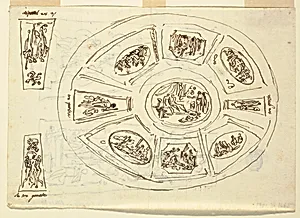
Oval Ceiling with Three Graces, Design for Sala di Enea, Palazzo Marescalchi, Bologna
Classification
figures
Department
Smithsonian Collection
Museum
Smithsonian American Art Museum
Credit
Museum purchase through gift of various donors
Accession Number
1901-39-1665
Rights
Public Domain
About this artwork
Research in Progress
Art Historical Context
Felice Giani, a prominent Italian Neoclassical artist (1758–1823), created this elegant *Oval Ceiling with Three Graces* in 1810 as a preparatory design for the Sala di Enea (Room of Aeneas) in Bologna's Palazzo Marescalchi. The palatial residence, a gem of Bolognese architecture, hosted grand decorative schemes that revived classical antiquity during the Napoleonic era, blending Roman mythology with refined elegance. At the heart of the composition are the Three Graces—Aglaia, Euphrosyne, and Thalia—symbols of beauty, joy, and charm from Greek mythology, often depicted in graceful, intertwined poses. Giani's neoclassical style, influenced by ancient frescoes and masters like Pompeo Batoni, emphasized harmonious figures and illusionistic architecture, perfect for an oval ceiling that would draw the eye upward in a fresco or painted ensemble. This design reflects the era's fascination with heroic narratives, as the room's name evokes Virgil's *Aeneid*. Now in the Smithsonian American Art Museum, acquired through generous donors, this preparatory work showcases Giani's skill in architectural ornamentation. Though research continues, it offers a window into early 19th-century Italy's cultural renaissance, inviting us to imagine the Graces dancing across Bologna's opulent skies.