
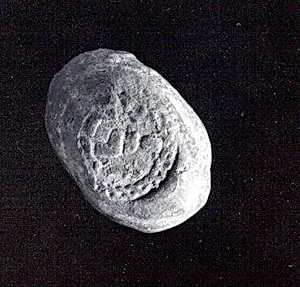
Oval sealing with one circular seal impression
Unknown Artist
ca. 18th century BCE
Medium
Un-baked clay
Dimensions
Diameter: Seal: 1.6 cm remaining Seal Face: Sealing: 2.86 x 2.0 cm Height: 1.63 cm
Classification
Clay-Sealings
Culture & Period
Old Assyrian Trading Colony · Middle Bronze Age–Old Assyrian Trading Colony
Department
Ancient Near Eastern Art
Museum
Metropolitan Museum of Art, New York, NY
Credit
Gift of Mrs. George D. Pratt, in memory of George D. Pratt, 1936
Accession Number
36.70.23
Rights
Public Domain
Art Historical Context
Step into the bustling world of Bronze Age trade with this delicate oval sealing from the Old Assyrian Trading Colony, dating to around the 18th century BCE. Crafted from un-baked clay—a fragile medium that preserved its authenticity—this small artifact (just 2.86 x 2.0 cm) bears a single circular seal impression, measuring 1.6 cm in diameter. Used in the ancient Near East, such sealings were pressed onto clay blobs to secure parcels, doors, or containers, ensuring goods remained tamper-proof during long-distance commerce. Hailing from the Middle Bronze Age hub of Assyrian merchants in Anatolia (modern Turkey), likely the site of Kanesh, this piece illuminates one of history's earliest global trade networks. Assyrian traders exported tin, textiles, and metals to Central Anatolia, fostering economic ties that spanned empires. The circular stamp seal impression, a common tool for authentication, reflects standardized administrative practices vital to this thriving colony. Though the exact motif is worn, its survival speaks volumes about daily life: contracts sealed, shipments guarded, trust built across vast distances. A gift to the Metropolitan Museum of Art in 1936, it invites us to ponder the unsung heroes of antiquity—merchants whose clay stamps wove the ancient economy together.