
Owl Mace Head
Unknown Artist
2nd–7th century
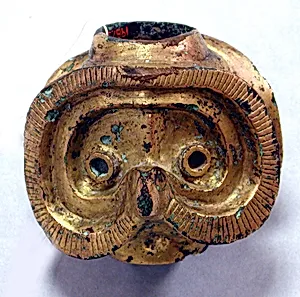
Medium
Copper (cast), gilt
Dimensions
H x W: 2 15/16 x 3 9/16in. (7.5 x 9cm)
Classification
Metal-Implements
Culture
Moche
Department
Arts of Africa, Oceania, and the Americas
Museum
Metropolitan Museum of Art, New York, NY
Credit
Bequest of Jane Costello Goldberg, from the Collection of Arnold I. Goldberg, 1986
Accession Number
1987.394.312
Rights
Public Domain
Tags
Art Historical Context
This exquisite Owl Mace Head, crafted by an unknown Moche artist between the 2nd and 7th centuries, hails from the ancient Moche culture of Peru's northern coast. Measuring just 2 15/16 x 3 9/16 inches (7.5 x 9 cm), this cast copper artifact, adorned with gilding, depicts a vigilant owl with finely detailed feathers and piercing eyes. As a metal implement, it likely served as the head of a ceremonial m—a symbol of power in Moche society, where such objects blended warfare, ritual, and elite status. The Moche were master metallurgists, renowned for their advanced techniques like lost-wax casting, which allowed for the intricate modeling seen here. Gilding the copper surface with a thin gold layer enhanced its prestige, evoking the divine shimmer associated with gods and rulers. Owls held potent symbolism in Moche iconography, often linked to the night, sorcery, or underworld deities, as evidenced by their frequent appearance in ceramics and textiles. Today, this rare treasure resides in the Metropolitan Museum of Art's Department of the Arts of Africa, Oceania, and the Americas, thanks to the bequest of Jane Costello Goldberg from the Collection of Arnold I. Goldberg in 1986. It offers a glimpse into the Moche's sophisticated worldview, where art and spirituality intertwined seamlessly.