
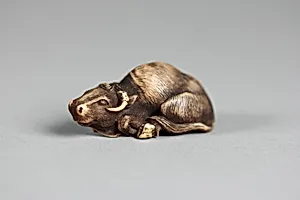
Ox
Unknown Artist
19th century
Medium
Ivory
Dimensions
H. 7/8 in. (2.2 cm); W. 2 in. (5.1 cm); D. 1 in. (2.5 cm)
Classification
Netsuke
Culture & Period
Japan · Edo (1615–1868) or Meiji period (1868–1912)
Department
Asian Art
Museum
Metropolitan Museum of Art, New York, NY
Credit
Bequest of Stephen Whitney Phoenix, 1881
Accession Number
81.1.108
Rights
Public Domain
Tags
Art Historical Context
Nestled in the Metropolitan Museum of Art Asian Art collection, this ivory netsuke titled *Ox* (19th century) captures the essence of Japanese craftsmanship from the late Edo (1615–1868) or early Meiji (1868–1912) period. Carved by an unknown artist, the sculpture measures just 7/8 inch high, 2 inches wide, and 1 deep—perfectly suited to its original purpose as a functional toggle. Netsuke were ingenious accessories used to secure inro (small medicine or tobacco pouches) to a kimono sash, evolving from practical items into coveted art forms prized for their whimsy and detail. Rendered in smooth, translucent ivory, the ox embodies strength and steadfastness, traits revered in Japanese culture where it ranks second in the zodiac cycle, symbolizing perseverance and agricultural bounty. The artist’s mastery shines in the subtle modeling of the animal’s muscular form, textured hide, and alert posture, achieved through precise carving techniques that highlight ivory’s natural sheen without added pigmentation. Such miniature sculptures were status symbols among samurai and merchants, blending utility with artistic expression. Bequeathed in 1881 by Stephen Whitney Phoenix, this ox invites visitors to appreciate the Edo-Meiji transition, when netsuke production peaked amid Japan’s opening to the West, preserving timeless motifs in enduring materials. A delightful window into everyday elegance!