
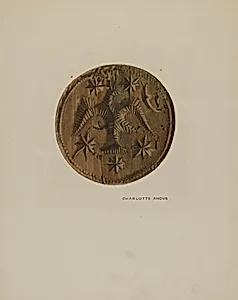
Pa. German Butter Mold
c. 1938
Medium
watercolor and graphite on paperboard
Dimensions
overall: 30.4 x 24 cm (11 15/16 x 9 7/16 in.) Original IAD Object: 4 3/4" high
Classification
Index of American Design
Department
CG-W
Museum
National Gallery of Art, Washington, D.C.
Credit
Index of American Design
Accession Number
1943.8.3759
Rights
Public Domain
Art Historical Context
This delicate watercolor and graphite by Charlotte Angus captures a Pennsylvania German butter mold around 1938. as part of the Index of American Design—a federal initiative during the Great Depression to document America’s decorative arts heritage—the work preserves the intricate details of a humble yet culturally rich household object. The original carved wooden mold, just 4¾ inches high, would have impressed decorative patterns into butter, blending utility with folk artistry. Pennsylvania German communities, often called Pennsylvania Dutch, brought these butter molds from Europe the 18th and 19th centuries. Craftsmen frequently adorned them with symbolic motifs such as hearts, tulips, birds, or religious imagery drawn from their agrarian and spiritual traditions. By rendering the object with precise graphite outlines and subtle watercolor washes, Angus highlights both its sculptural form and the tactile quality of the wood carving. As part of the National Gallery of Art’s collection, this piece exemplifies how the Index elevated everyday folk objects to subjects worthy of artistic study. It offers viewers a window into early American craftsmanship and the enduring beauty found in functional design.
About the Artist
Charlotte Angus · 1911–1989
Charlotte Angus (1911–1989) was an American artist renowned for her meticulous watercolors and graphite drawings that captured the essence of American folk art and historical artifacts. Born on February 2, 1911, in Kansas City, Missouri, she relocated to Philadelphia at a young age, where she immersed herself in the city's vibrant artistic community. Angus honed her skills at the University of the...