
Pa. German Butter Mold
c. 1940
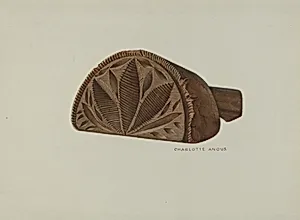
Medium
watercolor and graphite on paper
Dimensions
overall: 25.1 x 35.6 cm (9 7/8 x 14 in.) Original IAD Object: 7" wide; 3 1/2" high; 5 1/2" deep
Classification
Index of American Design
Department
CG-W
Museum
National Gallery of Art, Washington, D.C.
Credit
Index of American Design
Accession Number
1943.8.3783
Rights
Public Domain
Art Historical Context
This delicate watercolor and graphite rendering by Charlotte Angus captures a traditional Pennsylvania German butter mold from the early twentieth century. Created around 1940 as part of the Index of American Design, the drawing faithfully records an object measuring roughly seven inches wide, used by rural households to shape butter with decorative motifs. Such molds often featured carved designs like tulips, hearts, or birds, reflecting the strong cultural traditions brought by German-speaking immigrants to Pennsylvania. Angus worked in the precise, documentary style characteristic of the Index, a New Deal-era project that employed hundreds of artists to create accurate visual records of American folk and decorative arts before they disappeared. Using transparent watercolor over graphite on paper, she achieved both clarity of form and subtle tonal depth, allowing viewers to appreciate the mold’s craftsmanship and surface texture. Today, this work at the National Gallery of Art preserves not only the appearance of a humble kitchen tool but also the everyday artistry of Pennsylvania German communities, offering insight into regional identity and domestic life in early America.
About the Artist
Charlotte Angus · 1911–1989
Charlotte Angus (1911–1989) was an American artist renowned for her meticulous watercolors and graphite drawings that captured the essence of American folk art and historical artifacts. Born on February 2, 1911, in Kansas City, Missouri, she relocated to Philadelphia at a young age, where she immersed herself in the city's vibrant artistic community. Angus honed her skills at the University of the...