
Pa. German Saffron Box
c. 1941
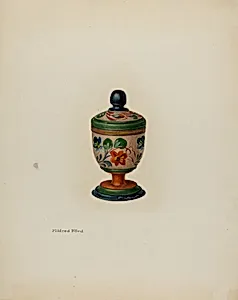
Medium
watercolor, graphite, and gouache on paper
Dimensions
overall: 36.5 x 29.2 cm (14 3/8 x 11 1/2 in.) Original IAD Object: 3 7/16" in diameter; 4 13/16" high
Classification
Index of American Design
Department
CG-W
Museum
National Gallery of Art, Washington, D.C.
Credit
Index of American Design
Accession Number
1943.8.3823
Rights
Public Domain
Art Historical Context
Behold the *Pa. German Saffron*, a meticulously rendered watercolor, graphite, and gouache by artist Mildred Ford, created around 1941. Measuring 36.5 x 29.2 cm, this work captures the intricate details of a small original object—just 3 7/16 inches in diameter and 13/16 inches—showcasing Ford's skill in mixed media. Watercolor provides luminous washes, graphite adds precise lines for contours and patterns, and gouache delivers bold, opaque colors typical of folk art reproduction. This artwork is a gem from the Index of American Design (IAD), a WPA Federal Art Project from 1935–1942 that employed artists to document everyday American folk objects through accurate, large-scale renderings. Ford's contribution preserves a Pennsylvania German saffron box, a practical container for the precious spice saffron, elevated by the community's vibrant decorative traditions rooted in 18th- and 19th-century German immigrant craftsmanship. These boxes exemplify Pennsylvania Dutch folk art's charm—often featuring carved, painted, or sgraffito designs with hearts, tulips, and geometric motifs symbolizing prosperity and heritage. Through Ford's lens, visitors glimpse a vanishing craft, bridging utilitarian beauty with cultural legacy at the National Gallery of Art.
About the Artist
Mildred Ford · 1895–1988
Mildred Ford (1895–1988) was an American artist whose career is indelibly linked to the Index of American Design, a monumental Works Progress Administration (WPA) project launched in the 1930s to document the nation's rich heritage of decorative arts and folk objects. Through her precise renderings, Ford helped preserve intricate details of everyday artifacts—from toleware utensils to Pennsylvania...