
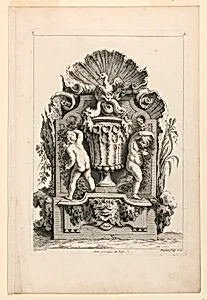
Page Five from "Premier Livre De Differents morceaux A l'Usage de tous ceux qui s'appliquent aux beuax Arts Inventé Par G.M. Oppenort Architecte du Roy Et Gravé par Huquier," Serie A (Moyen Oppenord)
after 1751
Medium
Classification
Department
Smithsonian Collection
Museum
Smithsonian American Art Museum
Credit
Smithsonian American Art Museum
Accession Number
1959-85-5
Rights
Public Domain
About this artwork
Research in Progress
Art Historical Context
Gilles-Marie Oppenord (2–1742), a prominent French architect to the King, created this intricate design as *Page Five* from his *Premier Livre de Différents Morceaux*, a seminal pattern book intended for artists and architects immersed in the fine arts. posthumously after 1751 and engraved by the skilled Huquier, this print belongs to Serie A (Moyen Oppen), showcasing Oppenord's mastery of the Régence style—a elegant precursor to full-blown Rococo, blending fluid curves, asymmetry, and ornate motifs inspired by nature and classical antiquity. As a single-sheet print, it exemplifies 18th-century reproductive techniques, where detailed engravings allowed widespread dissemination of innovative ornamental designs. These "morceaux" (pieces) served as practical templates for furniture, interiors, and decorative arts, influencing workshops across Europe. Oppenord's work, held in the Smithsonian American Art Museum's collection, reflects the era's fascination with luxury and refinement under Louis XV, bridging architecture and graphic arts. Though research continues, this page invites visitors to appreciate how such prints democratized high design, sparking creativity in the opulent world of ancien régime France.