
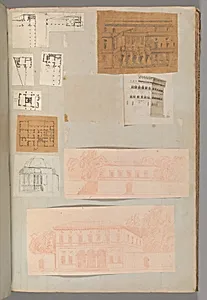
Page from a Scrapbook containing Drawings and Several Prints of Architecture, Interiors, Furniture and Other Objects
ca. 1800–1850
Medium
Pen and black and gray ink, graphite, black chalk
Dimensions
15 11/16 x 10 in. (39.8 x 25.4 cm)
Classification
Albums|Drawings|Prints|Ornament & Architecture
Department
Drawings and Prints
Museum
Metropolitan Museum of Art, New York, NY
Credit
The Elisha Whittelsey Collection, The Elisha Whittelsey Fund, 1963
Accession Number
63.535.122(a–j)
Rights
Public Domain
Tags
Art Historical Context
This captivating page from a scrapbook created by the renowned French architects Pierre François Léonard Fontaine and Charles Percier around 1800–1850, offers a window into the opulent world of Neoclassical design during the Napoleonic era. Fontaine and Percier, collaborators and imperial architects to Napoleon Bonaparte, pioneered the Empire style—a lavish revival of ancient Roman and Greek motifs adapted for modern grandeur. Here, meticulous drawings and prints showcase architecture, elegant interiors, furniture, and objects, reflecting their influence on Europe's decorative arts. The artwork's mixed media—pen and black and gray ink, graphite, and black chalk—demonstrate the precision essential for architectural planning and ornamentation. These techniques allowed for fine lines, subtle shading, and dynamic textures, capturing the symmetry and monumental scale that defined Empire aesthetics. As part of an album in the Metropolitan Museum of Art's Drawings and Prints department, it highlights how architects like Fontaine and Percier blurred lines between sketchbooks and design portfolios, inspiring furniture makers and decorators across the continent. Visitors will appreciate this piece's role in preserving the era's creative process, where personal scrapbooks served as treasure troves of ideas amid France's cultural renaissance. (198 words)
About the Artist
Pierre François Léonard Fontaine|Charles Percier · 1762–1853
Pierre François Léonard Fontaine (1762–1853) was a pivotal figure in French neoclassical architecture, renowned for his masterful interiors, urban planning, and decorative designs that defined the Empire style. Born in Pontoise to architect and fountain designer Pierre Fontaine, he assisted his father on hydraulic projects at the Château de L'Isle-Adam in 1778–1779 before moving to Paris in 1779. ...