
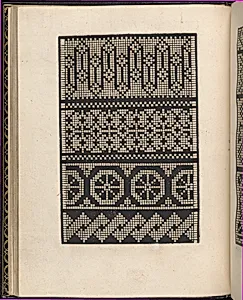
Page from Ein new kunstlich Modelbuch...(Page 21v)
1544
Medium
Woodcut
Dimensions
Overall: 7 11/16 x 5 7/8 in. (19.5 x 15 cm)
Classification
Books|Prints|Ornament & Architecture
Department
Drawings and Prints
Museum
Metropolitan Museum of Art, New York, NY
Credit
Rogers Fund, 1922
Accession Number
22.84.1(21v)
Rights
Public Domain
Tags
Art Historical Context
Step into the intricate world of Renaissance design with this woodcut page (21v) from *Ein new kunstlich Modelbuch ("A New Artistic Model Book"), printed by Peter Quel in 1544. Quentel, a prominent Cologne publisher, created this compact volume—measuring just 7 11/16 x 5 7/8 inches—as a treasure trove of ornamental patterns, blending architectural motifs and decorative flourishes ideal for craftsmen. Model books like this were revolutionary in 16th-century Europe, as go-to guides for artists, goldsmiths, and builders. They democratized sophisticated designs, spreading Renaissance ideals of symmetry, grotesques, and foliage-inspired ornaments from Italy northward. Quentel's woodcuts, carved in relief on wooden blocks, captured fine details with remarkable precision, allowing mass production alongside text—a hallmark of the printing revolution sparked by Gutenberg decades earlier. Housed in the Metropolitan Museum of Art's Drawings and Prints department (acquired via the Rogers Fund in 1922), this page exemplifies how printed ornament fueled cultural exchange, influencing everything from church altars to everyday objects. Imagine artisans across Europe poring over it, bringing these elegant patterns to life—what a window into the era's creative ingenuity!
About the Artist
Peter Quentel · 1500–1550
Peter Quentel (ca. 1500–1546) was a prominent German printer and publisher based in Cologne, active from 1518 until his death on March 1, 1546. The son of the esteemed printer Heinrich Quentel (d. 1501), Peter began issuing books under his own name around 1518 and fully assumed control of the family press by 1520, eventually serving multiple terms as a Cologne city councilman. His early life is no...