
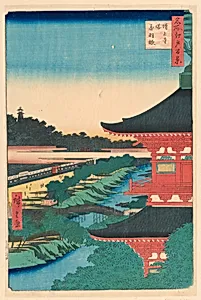
Pagoda of Zojoji Temple, Akabane (Zojoji-to, Akabane) From the Series One hundred views of Edo
Classification
landscapes
Department
Smithsonian Collection
Museum
Smithsonian American Art Museum
Credit
Gift of the Estate of Mrs. Robert H. Patterson
Accession Number
1941-31-259
Rights
Public Domain
About this artwork
Research in Progress
Art Historical Context
Ando Hiroshige’s “Pagoda of Zojoji Temple, Akabane” belongs to his celebrated series *One Hundred Views of Edo*, completed in 1857, just a year before the artist’s death. Created during Japan’s late Edo period, the print captures a tranquil moment at Zojoji, one of Tokyo’s most important temples, whose five-story pagoda rises against a softly graded sky. Hiroshige, a master of the ukiyo-e tradition, used subtle color gradations and elegant composition to evoke both the serenity and the fleeting beauty of the urban landscape. The series as a whole documented the changing face of Edo (modern Tokyo) at a pivotal moment when Japan was beginning to open to the outside world. Hiroshige’s sensitive treatment of light, weather, and seasonal atmosphere helped elevate landscape prints from simple souvenirs to respected works of art. Today the image offers viewers a quiet window into mid-nineteenth-century Japanese life, where sacred architecture and everyday surroundings coexist in harmonious balance. Housed in the Smithsonian American Art Museum, this impression continues to introduce new generations to Hiroshige’s poetic vision and the enduring appeal of ukiyo-e landscapes.