
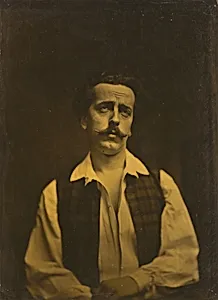
Painful recollection or painful thoughts
1854-1856, printed 1862
Medium
albumen print
Dimensions
image: 21.8 × 15.8 cm (8 9/16 × 6 1/4 in.) mount: 40.3 × 27.3 cm (15 7/8 × 10 3/4 in.)
Classification
Photograph
Department
CPH
Museum
National Gallery of Art, Washington, D.C.
Credit
W. Bruce and Delaney H. Lundberg Fund, in Honor of the 25th Anniversary of Photography at the National Gallery of Art
Accession Number
2015.52.7
Rights
Public Domain
Art Historical Context
In the mid-19th century, neurologist and photographer Guillaume-Benjaminmand Duchenne de Boulogne pioneered the use of photography to capture authentic human emotions. *Painful Recollection or Painful* (1854–1856, 1862) is a striking example from his groundbreaking series *Mécanisme de laionomie humaine*. Using mild electrical stimulation on facial muscles, Duchenne genuine expressions of distress, photographing subjects to scientifically document the "language of the face." This image poignantly conveys inner turmoil, with furrowed brows and tense features revealing the raw mechanics of sorrow. Rendered as an albumen print—a refined 19th-century process coating paper with egg whites and silver salts for exceptional detail and warm tones—the work exemplifies early scientific photography's artistic potential. Measuring just 21.8 × 15.8 cm on its mount, it bridges medicine and visual art, influencing Charles Darwin's studies on emotion and laying groundwork for modern psychology and film. Today, housed in the National Gallery of Art (CPH Department), this piece invites visitors to ponder how a single frozen moment can universalize human suffering, blending empirical rigor with emotional depth.
About the Artist
Guillaume-Benjamin-Amant Duchenne (de Boulogne)
Guillaume-Benjamin-Amant Duchenne de Boulogne (1806–1875) was a French neurologist whose pioneering use of photography to document human facial expression placed him at the unique intersection of medical science and visual art. Though primarily a physician rather than an artist in the conventional sense, his photographic work — produced in the 1850s and 1860s — has been recognized as a significant...