
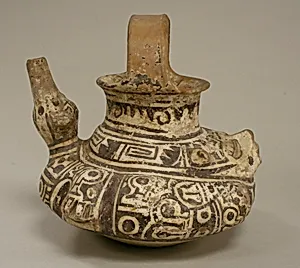
Painted Animal Vessel
Unknown Artist
10th–13th century
Medium
Ceramic, slip, pigment
Dimensions
H. 7 7/8 × W. 7 1/2 × D. 8 3/4 in. (20 × 19.1 × 22.2 cm)
Classification
Ceramics-Containers
Culture
Huastec
Department
Arts of Africa, Oceania, and the Americas
Museum
Metropolitan Museum of Art, New York, NY
Credit
The Michael C. Rockefeller Memorial Collection, Purchase, Anonymous Gift, 1966
Accession Number
1978.412.155
Rights
Public Domain
Tags
Art Historical Context
This enchanting Painted Animal Vessel hails from the Huaste culture of Mexico's Gulf Coast, dating to the 10th–13th century during the Postclassic period. Huastec people, for their vibrant artistic traditions influenced by broader Mesoamerican styles yet distinctly their own, crafted such ceramics as part of daily life and ritual practices. Shaped as a container—likely evoking a specific animal form—this piece reflects the Huastec fascination with the animal world, where creatures often symbolized fertility, protection, or spiritual forces in their cosmology. Crafted from ceramic with slip (a fine clay mixture for smooth surfaces) and vibrant pigments, the vessel showcases sophisticated prehispanic techniques. At just under 8 inches tall, wide, and deep, its compact form allowed for both practical use and display. The applied slip and pigments created bold, enduring decorations, highlighting the Huastec mastery of firing processes that preserved intricate patterns against time. Now part of The Metropolitan Museum of Art's Michael C. Rockefeller Memorial Collection, this vessel offers a window into Huastec ingenuity, bridging utility and artistry in ancient Americas. Visitors are invited to imagine it filled with offerings or liquids in a bustling prehispanic household.