
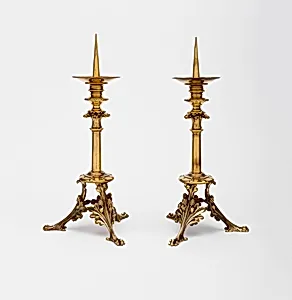
Pair of Altar Candlesticks
Medium
Gilded cast bronze
Dimensions
1: 42.3 × 20.8 × 18.6 cm (16 5/8 × 8 3/16 × 7 5/16 in.); 2: 41.6 × 20.4 × 18.1 cm (16 3/8 × 8 × 7 1/8 in.)
Classification
altar candlesticks
Department
Applied Arts of Europe
Museum
Art Institute of Chicago
Accession Number
238983
Rights
Public Domain
About this artwork
These candlesticks are based on a design developed by Eugène Viollet-le-Duc to furnish a chapel in the Paris cathedral of Notre-Dame. Viollet-le-Duc was one of the architects responsible for restoring Notre-Dame in the 1840s, following the damage and destruction of many religious sites during the French Revolution. His designs, inspired by the Gothic style of the medieval period, also proved popular among a secular clientele. Candlesticks of this design remained in production as late as 1889, wh...
Art Historical Context
Created in 1862 by the renowned French architect and designer Eugène-Emmanuel Viollet-le-Duc these Pair of Altar Candlesticks exemplify the refined craftsmanship of 19th-century European applied arts. Viollet-le-Duc, celebrated for his restorations of Gothic cathedrals such as Notre-Dame in Paris, brought his deep appreciation for medieval forms to decorative objects. Cast in bronze and richly gilded, the candlesticks would have gleamed under church lighting, their warm golden surfaces enhancing the solemn atmosphere of religious ceremonies. The medium of gilded cast bronze allowed for intricate detailing while ensuring durability for liturgical use. Slight differences in the dimensions of the two pieces—roughly 42 centimeters tall—highlight the handcrafted nature of the work, where each element was individually modeled and finished. As part of the Applied Arts of Europe collection at the Art Institute of Chicago, these candlesticks reflect the 19th-century revival of historic styles and the era’s interest in blending architectural principles with functional church furnishings. Their elegant proportions and material richness continue to invite viewers to appreciate the intersection of design, faith, and artistry.