
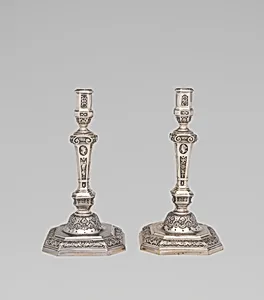
Pair of candlesticks
1690–91
Medium
Silver
Dimensions
Each: H. 9-1/4 in. (23.5 cm.); L. 5 1/8 in. (13.0 cm.)
Classification
Metalwork-Silver
Culture
French, Paris
Department
European Sculpture and Decorative Arts
Museum
Metropolitan Museum of Art, New York, NY
Credit
Bequest of Catherine D. Wentworth, 1948
Accession Number
48.187.249, .250
Rights
Public Domain
Art Historical Context
Crafted in Paris around 1690–91 by master silversmith Jacques Demé, this exquisite pair of silver candlest exemplifies the grandeur of late Baroque French decorative arts. Standing at just over 9 inches tall and 5 inches long each, their compact yet elegant form made them ideal for intimate dining tables or private chambers in affluent homes. Demé, a registered Parisian maker, bore the official poinçons (hallmarks) that guaranteed the silver's purity and origin, a hallmark of the guild-regulated luxury trade under Louis XIV. During the Sun King's reign, silver objects like these were symbols of wealth and refinement, often rivaling the opulence of Versailles itself. Parisian silversmiths pioneered intricate chasing, engraving, and casting techniques, transforming functional items into sculptural masterpieces. These candlesticks likely featured flared bases and baluster stems typical of the period, evoking the rhythmic curves of contemporary architecture and furniture. Today, housed in the Metropolitan Museum of Art's European Sculpture and Decorative Arts department through the 1948 bequest of Catherine D. Wentworth, they offer a glimpse into France's golden age of metalwork—a time when silver not only illuminated spaces but also status. Visitors, imagine their soft glow casting shadows on gilded walls!