
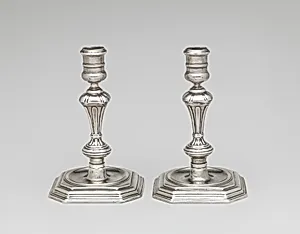
Pair of candlesticks
1710/11
Medium
Silver
Dimensions
Overall (.142, confirmed): 6 1/8 x 3 7/8 x 3 7/8 in., 11 oz. 18 dwt. (15.6 x 9.8 x 9.8 cm, 0.3705kg); Overall (.143, confirmed): 6 x 3 7/8 x 3 7/8 in., 11 oz. 11 dwt. (15.2 x 9.8 x 9.8 cm, 0.359kg)
Classification
Metalwork-Silver
Culture
British, London
Department
European Sculpture and Decorative Arts
Museum
Metropolitan Museum of Art, New York, NY
Credit
Bequest of Mary Strong Shattuck, 1935
Accession Number
35.80.142, .143
Rights
Public Domain
Art Historical Context
These elegant pair of silver candlesticks, crafted the skilled London silversmith David Willaume in 1710 or 1711, exemplify refined metalwork of early 18-century Britain. Standing about 6 inches tall with square bases measuring nearly 4 inches across, they weigh around 11 ounces each, their subtle variations in height (15.6 cm and 15.2 cm) highlighting the handcrafted precision of the era. Produced during Queen Anne's reign, such pieces were hallmarks of London’s thriving silver trade, where Huguenot immigrants like Willaume brought continental expertise to British workshops. Silver candlesticks held both practical and symbolic importance, illuminating grand dining tables while signaling wealth and status among the elite. Willaume’s work reflects the period’s shift toward balanced, geometric forms—away from ornate Baroque excess toward the emerging Queen Anne style’s understated grace. The medium of silver, prized for its luster and durability, was marked with London hallmarks to guarantee purity and origin, techniques involving casting, chasing, and polishing that demanded masterful skill. Today, this pair graces the Metropolitan Museum of Art’s European Sculpture and Decorative Arts collection, a bequest from Mary Strong Shattuck in 1935. They invite us to imagine candlelit evenings in Georgian homes, where light danced across polished surfaces, blending utility with artistry.