
Pair of Flintlock Pistols
ca. 1750–70
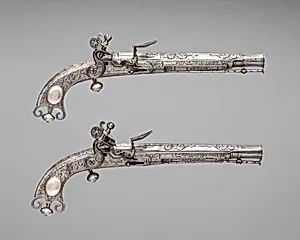
Medium
Steel, silver
Dimensions
L. 11 3/4 in. (29.8 cm)
Classification
Firearms-Pistols-Flintlock
Culture
Scottish, Doune
Department
Arms and Armor
Museum
Metropolitan Museum of Art, New York, NY
Credit
Gift of Edward Coe Embury Jr., Philip Aymar Embury, and Dorothy Embury Staats, in memory of Aymar Embury II and his wife, Jane Embury Benepe, 2000
Accession Number
2000.194.1, .2
Rights
Public Domain
Art Historical Context
Step into the world of 18th-century Scotland with this exquisite pair of flintlock pistols by Alexander Campbell of Doune around 1750–70. Measuring 11 3/4 inches in, these steel and silver masterpieces exemplify the renowned gunsmithing tradition of Dou, a small Perthshire town famous for producing some of Europe's finest firearms. Campbell's work reflects the era's blend of functionality and artistry, where pistols served not just as weapons but as status symbols for gentlemen, officers, and duelists. Flintlock mechanisms, like those here, revolutionized handheld firearms by providing reliable ignition through a sparking flint against steel, making them a staple from the late 17th to early 19th centuries. The silver mounts—likely including ornate mounts, triggers, and barrel bands—add a layer of opulent decoration, showcasing silversmithing techniques that elevated these pistols beyond mere tools of war. Housed in the Metropolitan Museum of Art's Arms and Armor Department, this pair was generously gifted in 2000, honoring the donors' family legacy. These pistols offer a window into Scotland's vibrant craft heritage during a time of political upheaval, including the Jacobite risings, when finely made arms were both practical and prestigious. A testament to skilled metallurgy and design, they invite us to admire the intricate balance of form, function, and flair in historical weaponry.
About the Artist
Alexander Campbell · 1690–1790
Alexander S. Campbell (b. 1932) was a Scottish artist and educator born in Edinburgh, where he spent much of his life. He received his formative training at the Edinburgh College of Art from 1951 to 1958, earning a master's degree with honors. There, he studied under the esteemed painters William Gillies and Robin Philipson, whose influences shaped his approach to composition and color. Campbell f...