
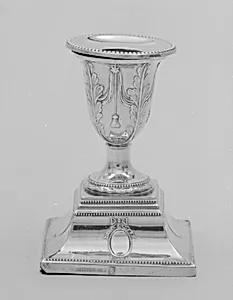
Pair of piano candlesticks
ca. 1784
Medium
Sheffield plate
Dimensions
Height (each): 4 3/16 in. (10.6 cm)
Classification
Metalwork-Silverplate
Culture
British
Department
European Sculpture and Decorative Arts
Museum
Metropolitan Museum of Art, New York, NY
Credit
Gift of Frances and Edward Munves, 1964
Accession Number
64.187.2a, b, .3a, b
Rights
Public Domain
Art Historical Context
These delicate **Pair of Piano Candlesticks**, crafted by N. Smith and. around 1784, exemplify the ingenuity of British metalwork during the late Georgian era. Standing just 4 3/16 inches (10.6 cm) tall, these petite silverplate treasures were designed to perch on pianos or harpsichords, sheet music for evening recitals in fashionable homes. Produced in Sheffield, England—the epicenter of innovative plating techniques—they reflect the growing popularity of domestic music-making among the rising middle class. The medium, Sheffield plate, was a groundbreaking 18th-century innovation, fusing a thin layer of silver to a copper base through heat and pressure. Patented in the 1740s, it offered the luster of solid silver at a fraction of the cost, revolutionizing decorative arts and enabling wider access to luxury goods. N. Smith and Co., prominent Sheffield platers, mastered this labor-intensive process, creating pieces that combined neoclassical elegance with practical functionality. Housed in The Metropolitan Museum of Art's Department of European Sculpture and Decorative Arts (gift of Frances and Edward Munves, 1964), these candlesticks capture a moment when music, refinement, and manufacturing prowess intertwined, bringing a touch of 18th-century salon glamour to modern viewers.