
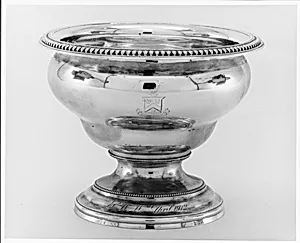
Waste Bowl
1827
Medium
Silver
Dimensions
Overall: 5 1/4 x 6 7/8 in. (13.3 x 17.5 cm); 19 oz. 2 dwt. (594.6 g) Foot: Diam. 4 5/8 in. (11.7 cm)
Classification
Waste Bowl
Culture
American
Department
The American Wing
Museum
Metropolitan Museum of Art, New York, NY
Credit
Gift of Mrs. Arthur C. Steinbach, 1968
Accession Number
68.130.4
Rights
Public Domain
Art Historical Context
Nestled in the Metropolitan Museum of Art's American Wing, Harvey Lewis's *Waste Bowl* (1827) exemplifies the refined craftsmanship of early 19th American silversmithing Crafted from gleaming silver this elegant vessel measures 5 1/4 x 6 7/8 inches overall, weighing a substantial 19 oz. 2 dwt., with a foot diameter of 4 5/8 inches. Lewis, a skilled New York silversmith active the Federal period's transition to Classical Revival, produced pieces like this for affluent households, where silver tableware symbolized taste and prosperity. Waste bowls were essential to formal tea services, designed to catch discarded tea leaves from strainers, reflecting the ritualistic social customs of the era. This functional yet beautiful object highlights the technical prowess of American artisans, who rivaled European counterparts in chasing, engraving, and shaping silver. Donated by Mrs. Arthur C. Steinbach in 1968, it offers a tangible glimpse into post-Revolutionary America's growing sophistication and love for neoclassical elegance. Today, it invites visitors to ponder the daily luxuries of 1820s elites, bridging utility and artistry in a single, shimmering form.