
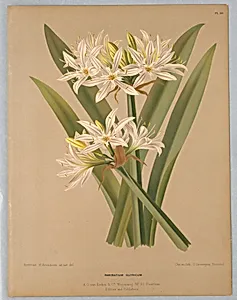
Pancratium Illyricum, Plate 116 from A. C. Van Eeden's "Flora of Haarlem"
Medium
Classification
Department
Smithsonian Collection
Museum
Smithsonian American Art Museum
Credit
Gift of Hamill and Barker
Accession Number
1961-105-398
Rights
Public Domain
About this artwork
Research in Progress
Art Historical Context
**Pancratium Illyricum, Plate 116** from A. C. Van Eeden's *Flora of Haarlem is a delicate botanical print by Dutch artist Arentine H. Aren (1836–1915), created around 1881. This work captures the elegant Pancratium illyricum—a rare coastal lily native to the Mediterranean—showcasing its slender stems, starry white flowers, and intricate details with scientific precision. As plate 116 in Van Eeden's comprehensive flora, it documents the plant life of Haarlem, Netherlands, blending artistry with botany during a golden age of natural history illustration. Arendsen, a skilled 19th-century Dutch illustrator, exemplifies the era's chromolithographic techniques, where hand-colored prints brought scientific accuracy to life for scholars and enthusiasts alike. These prints from *Flora of Haarlem* reflect the Victorian fascination with nature's diversity, serving as both educational tools and aesthetic treasures. Today, this piece graces the Smithsonian American Art Museum's collection, gifted by Hamill and Barker, highlighting the cross-cultural exchange of botanical knowledge. Though research continues, its presence invites visitors to appreciate how 19th-century artists like Arendsen bridged science and beauty, preserving fragile flora for generations.