
Panel
Unknown Artist
13th century
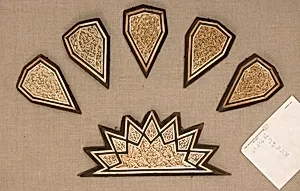
Medium
Wood; carved, inlaid with ivory
Dimensions
Largest piece (Semi-circle): Max H. 4 7/8 in. (12.4 cm) Max W. 11 1/4 in. (28.5 cm) D. 11/16 in. (1.8 cm) Smallest piece (Triangular shape): Max H. 5 3/8 in. (13.7 cm) Max W. 3 3/8 in. (8.5 cm) D. 11/16 in. (1.8 cm)
Classification
Wood
Department
Islamic Art
Museum
Metropolitan Museum of Art, New York, NY
Credit
Rogers Fund, 1907
Accession Number
07.236.31
Rights
Public Domain
Art Historical Context
This exquisite 13th-century carved wood panel, inlaid with ivory, hails from the Islamic world and exemplifies the refined craftsmanship of medieval Islamic art. Comprising fragments like a semi-circular piece (measuring 4 7/8 inches high and 11 1/4 inches wide) and a triangular one5 3/8 inches high and3 3/8 inches wide), it showcases delicate openwork carving and intricate inlays, creating a luminous interplay of light and shadow. Acquired through the Rogers Fund in 1907, it now graces the Metropolitan Museum of Art Islamic Art department. Such panels were likely used in architectural elements like doors, screens, or furniture, reflecting the era's emphasis on geometric precision and organic motifs—hallmarks of Islamic decorative arts. The technique of ivory inlay on wood, known as *tarz-i naqsh*, elevated everyday objects into symbols of luxury and piety, often adorning mosques, palaces, or scholarly spaces across regions like Syria or Egypt during the Ayyubid period. Though the artist remains unknown, this panel's survival speaks to the enduring allure of Islamic woodwork, blending functionality with spiritual elegance. Visitors can appreciate how its slim 11/16-inch depth allowed for portability while inviting tactile wonder.