
Panel
Unknown Artist
13th century
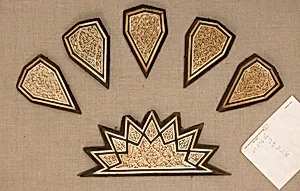
Medium
Wood; carved, inlaid with ivory
Dimensions
H. 5 3/8 in. (13.7 cm) W. 3 3/8 in. (8.5 cm) D. 11/16 in. (1.8 cm)
Classification
Wood
Department
Islamic Art
Museum
Metropolitan Museum of Art, New York, NY
Credit
Rogers Fund, 1907
Accession Number
07.236.26
Rights
Public Domain
Art Historical Context
This delicate wooden panel, crafted by an unknown artist in the 13th century, exemplifies the refined artistry of Islamic decorative traditions. Measuring just 5 3/8 by 3 3/8 inches, its petite scale suggests it once adorned a small piece of furniture, a casket, or architectural element in a palace or mosque. Carved from wood and meticulously inlaid with ivory, the piece showcases the intricate *taracea* technique—where thin ivory pieces are fitted into precisely carved recesses—creating luminous contrasts and intricate patterns that catch the light. Dating to the medieval Islamic world, likely from regions like Syria, Egypt, or Iraq amid the turbulent era of Mongol invasions and Mamluk ascendancy, such panels highlight the era's emphasis on geometric and arabesque designs. These motifs symbolized infinity and divine order, adhering to aniconic principles that favored abstraction over human figures. The labor-intensive ivory inlay, a luxury material sourced from elephant tusks, underscores the patronage of wealthy courts, where artisans blended woodworking prowess with jewel-like precision. Acquired through the Rogers Fund in 1907 and now housed in the Metropolitan Museum of Art's Islamic Art department, this panel invites us to marvel at the anonymous master's skill. It reminds visitors of how everyday objects in Islamic culture doubled as profound expressions of faith, beauty, and technical virtuosity.