
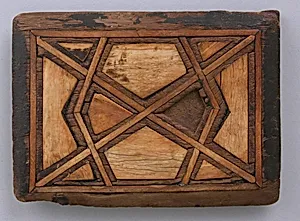
Panel
Unknown Artist
14th–15th century
Medium
Wood; carved, inlaid with ivory
Dimensions
Ht. 3 3/16 in .(8.1 cm) W. 4 3/8 in. (11.1 cm) D. 1/2 in. (1.2 cm)
Classification
Wood
Department
Islamic Art
Museum
Metropolitan Museum of Art, New York, NY
Credit
Rogers Fund, 1907
Accession Number
07.236.61
Rights
Public Domain
Art Historical Context
This exquisite wooden panel, crafted by an unknown artist in the th–15th century exemplifies the refined artistry of Islamic decorative traditions. Measuring just over 3 inches high and4 inches wide, its modest scale suggests it may have adorned a small furniture piece, such as a box or casket, common in the opulent courts of the medieval Islamic world. Housed in the Metropolitan Museum of Art's Art Department (acquired through the Rogers Fund in 7), it showcases the era's mastery of intricate craftsmanship. The panel's medium—wood meticulously carved and inlaid with ivory—highlights a prestigious technique prevalent in regions like Egypt and Syria under Mamluk patronage. Ivory inlays, prized for their luminous quality, were laboriously cut and fitted into recessed wood designs, creating contrasting textures and subtle sheen. This method not only demonstrated exceptional skill but also symbolized luxury, as ivory was a rare import, often from Africa or India. Such panels reflect the cultural emphasis on geometric precision and harmonious patterns in Islamic art, avoiding figural representation to evoke spiritual contemplation. Though its exact motifs remain unrecorded here, it invites visitors to appreciate the anonymous genius behind everyday splendor, bridging the gap between utility and divine beauty in medieval Islamic society.