
Panel
Unknown Artist
14th–15th century
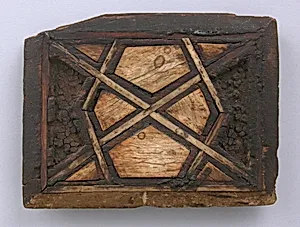
Medium
Wood; carved, inlaid with ivory
Dimensions
Ht. 3 1/4 in. (8.2 cm) W. 4 5/16 in. (11 cm) D. 9/16 in. (1.4 cm)
Classification
Wood
Department
Islamic Art
Museum
Metropolitan Museum of Art, New York, NY
Credit
Rogers Fund, 1907
Accession Number
07.236.64
Rights
Public Domain
Art Historical Context
This delicate wooden panel, crafted by an unknown artist in the th–15th century exemplifies the refined artistry of Islamic woodworking traditions. Measuring just 3¼ inches high and 4⅜ inches wide, its modest scale suggests it may have adorned a small object like a box, casket, or furniture inlay, common in the opulent households or religious settings of the medieval Islamic world. The mediumwood meticulously carved and inlaid with ivory—high a sophisticated technique known as ivory marquetry, where thin ivory pieces were precisely cut and embedded into the wood to create intricate patterns, often geometric or arabesque designs that evoke harmony and infinity. In the Islamic art of this era, such panels held cultural significance as symbols of piety, luxury, and technical mastery. Artisans in regions like Mamluk Egypt or Syria perfected these methods, drawing on mathematical precision to produce luminous contrasts between the warm wood tones and the glowing ivory. The shallow depth of ⁹⁄₁₆ inch underscores the panel's portability and fine craftsmanship, likely intended for close appreciation. Acquired through the Rogers Fund in 1907 and now housed in The Metropolitan Museum of Art's Islamic Art Department, this piece invites visitors to marvel at the enduring elegance of anonymous makers whose skill transcended time, offering a window into a golden age of decorative innovation.